|
|
 |
|
|
|
 |
|
|
|
 |
|
|
|
|
|
|
|
|
|
ArtiSmile Dental Laboratory has wonderful news that benefits you and your client! Recently,
ArtiSmile started using a new product called 3M™ ESPE™ Lava™. Lava™ is used to make
crowns and bridges with conventional techniques and unconventional results!
|
|
|
|
|
|
|
|
|
|
|
|
Lava™ All Ceramic System
 | | The superior strength of zirconia
|
| | Highest-strength class of ceramic material
|
| | Less water absorption
|
| | Less cracking, less fracturing, greater durability
|
| | Outstanding marginal fit
|
| | Excellent esthetics and translucency
|
| | Conventional technique and cementation
|
| | More than four years of clinical history
|
| | Ideal for three-unit bridges |
| | |
Lava™ Crowns & Bridges
| | Patented substructure available in 8 different shades
|
| | Zirconia provides proven high strength performance
|
| | More than 25 years zirconia research and technology
|
| | Precision CAD/CAM system for outstanding marginal fit
|
| | Five years of clinical history and proven results
|
| | Natural translucency and unmatched esthetics
|
| | Indicated for anterior and posterior crowns and bridges
|
| | Conventional cementation
|
| | Minimal removal of tooth structure |
| | |
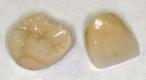
The 3M™ ESPE™ Lava™ Crowns and Bridges system is an innovative CAD/CAM technology
using a zirconium oxide base. The durability and esthetics of Lava restorations represent the optimum
in all-ceramic systems. Preparations require removal of less tooth structure, and cementation can be
accomplished using proven, conventional techniques. Colorable frameworks that are thin and
translucent ensure a natural and vital appearance. The result is a restoration ideal for single crowns,
three- and four-unit bridges with multiple abutments, splinted crowns (up to four units), and cantilever
bridges (except single abutment) that offer strength, stability and outstanding marginal fit.
With the Lava™ System, 3M™ ESPE™ presents innovative CAD/CAM technology for all-ceramic
crowns and bridges on a zirconia base.
Due to the remarkable strength, stability and esthetics of zirconia, Lava™ Crowns and Bridges are
indicated for the anterior as well as for the posterior region. Excellent fit is guaranteed by a perfectly
coordinated system.
A tooth structure friendly preparation can be achieved, and cementation can be carried out
according to proven conventional techniques. In order to combine the advantages of an adhesive
cementation with the simple handling of a conventional cementation, the new self-adhesive cement
RelyX™ Unicem can be used for an easy-handling.
The esthetics and durability of Lava™ restorations represents the optimum in all-ceramic systems.
Colorable frameworks of ideal translucency and thin veneer ceramic layer ensure a natural
appearance due to the wide scope of esthetic.
The milling of zirconia frameworks in the presintered state prevents damage of the microstructure of
the material, and ensures an excellent long-term perspective for Lava™ restorations.
Benefits
| | Excellent esthetics and translucency.
|
| | Outstanding marginal fit.
|
| | Superior strength of zirconia with high fracture resistance.
|
| | Preparation is similar to PFM.
|
| | Preparations require removal of less tooth structure.
|
| | Cementation can be accomplished using proven, conventional techniques.
|
| | Shaded frameworks are thin and translucent to ensure a natural and vital
|
appearance.
| | Easy-to use custom veneering ceramic applies directly to coping surface
|
without bonding systems or opaquer. Designed to meet the coefficient of thermal
expansion of Lava Frame Zirconia.
| | Ideal for 3- and 4-unit bridge, crown and splinted crown applications.
|
| | Lava™ Frame Zirconia is available in 8 shades to provide better matching
|
to the natural original tooth.
| | Lava™ Ceram is available in 16 shades. The color range comprises the
|
following components: 16 framework modifiers, 16 dentin materials, 10 magic
materials, 4 enamel materials, 2 enamel effect materials, 7 shoulder materials, 4
Transpa-Opal materials, 16 modifier materials, 10 extrinsic stains, 2 glazes and
accompanying mixing liquids. | |
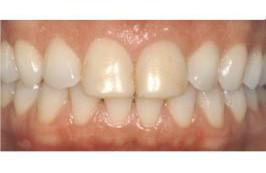
BEFORE
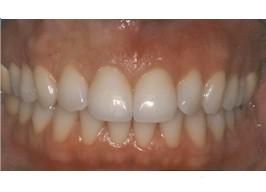
AFTER
|