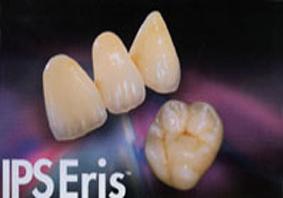
IPS ERIS
IPS Eris™ is a new low-fusing layering material to be used with lithium disilicate frameworks.
This proven apatite glass-ceramic provides life-like translucency, brightness and it has light
scattering qualities for true-to-nature opalescence. IPS Eris™ offers a full range of occlusal
dentin, mamelon and opal effect materials for more individualized characterizations and four
ultra-light bleach shades for all your patients needs. IPS Eris offers conventional cementation
for trouble-free insertion or it is also possible to use adhesive cementation. Indications for IPS
Eris layering technique are anterior and posterior crowns and three-unit bridges with one
pontic, up to the second premolar as the distal abutment.
Advantages / Benefits
 | | True-to-nature esthetics
|
| | Homogeneous leucite crystal distribution allowing for:
|
| | Higher flexural strength
|
| | Improved optical properties
|
| | Optimized colour and clarity
|
IPS Eris
Advantages/benefits
| | Natural translucency
|
| | High strength
|
| | Wear compatibility
|
| | Excellent margin adaptation
|
Indications
| | Full-coverage crowns
|
| | 3-unit bridges (up to the 2nd premolar)
|
Cementation
| | Conventionally cemented with glass ionomer cement or
|
enamel-dentin adhesive bonding system | |
IPS Eris provides breathtaking aesthetics for anterior & posterior crowns and three
unit bridges:
| | Lithium Disilicate glass-ceramic that wears the same as tooth enamel | | | Increased strength and fracture resistance (nearly 3 times stronger than IPS
Empress)
| | | Veneering porcelain contains fluorapatite crystals that are similar in structure | | | and optical properties to natural dentition Placement: adhesive bonding is preferred
|
|